

Part 1: Introduction
Math has long been linked with memorisation. Many of us remember reciting times tables, drilling formulas, and repeating step-by-step procedures until they became instinctive. This style of learning, known as rote memorisation, has traditionally shaped how students are taught in classrooms. While it certainly helps children gain basic numeracy, the danger lies in relying on memorisation alone.
Students who only learn by rote often miss the bigger picture. They may be able to recite formulas quickly but struggle when questions are phrased differently or when real-world applications are involved. This can limit creativity and slow down the development of critical thinking in math education.
Recognisiting this limitation, modern education has since moved away from rote questions, instead placing more emphasis on deeper learning. This is also reflected in the way Singapore’s maths tuition centres are designing their programmes to adapt to this shift. This is where conceptual learning comes into play. Instead of asking students to simply recall information, it helps them uncover the “why” and “how” behind mathematical ideas. This approach strengthens math problem-solving skills and builds confidence that will serve them well even beyond exams.
In this article, we will explore what conceptual learning means, how it differs from rote memorisation, and why it is essential in building strong foundations for lifelong success in mathematics.
Key Takeaways
- Understanding mathematical ideas deeply allows students to connect concepts, apply knowledge in new contexts, and strengthen problem-solving skills.
- Memorisation alone may build speed, but it limits flexibility and long-term retention when faced with unfamiliar challenges.
- A balanced approach that blends understanding with fluency equips learners for confidence and success in school and beyond.
Part 2: Overview of Conceptual Learning

2.1. What Is Conceptual Learning in Math?
In essence, conceptual learning in mathematics is about moving beyond surface-level recall to a deeper grasp of ideas. Instead of drilling formulas or memorising step-by-step solutions, students are guided to uncover the underlying principles that explain why those formulas work. This approach is what builds true conceptual understanding in mathematics, giving learners the confidence to solve not just familiar problems but also those that look different or unfamiliar.
For instance, a child who memorises that the formula for the area of a rectangle is “length × width” may know the answer quickly, but one who understands that area measures how many unit squares fit inside a shape has a much stronger foundation. This understanding can then be extended to more complex figures such as triangles, parallelograms, or circles.
Conceptual learning focuses on meaning-making. It highlights relationships, patterns, and connections across mathematical topics. Rather than seeing math as isolated procedures, students begin to appreciate it as a logical, interconnected system. This makes learning more engaging and practical, especially when it comes to questions that require reasoning and explanation.
Key features of conceptual learning include:
- Focus on understanding: Prioritises comprehension over memorisation of isolated facts.
- Connection-building: Helps learners relate new concepts to what they already know.
- Encourages higher-order thinking: Develops analysis, evaluation, and synthesis skills.
- Promotes active learning in mathematics: Often involves problem-solving, discussions, and critical thinking.
- Enables knowledge transfer: Students learn to apply concepts in both familiar and new contexts.
- Improves retention: Understanding relationships makes it easier to recall and apply ideas over time.
By nurturing these habits of thought, students are better-equipped for exams, and this preparedness will also help their confidence when tackling challenges in general.
2.2. What are the Key Benefits of Conceptual Learning in Math?
The advantages of conceptual learning stretch far beyond doing well in school exams. By focusing on meaning rather than memorisation, students develop a stronger foundation that supports them throughout their academic journey and into real-world applications. Here are the main benefits:
1. Enhances Problem-Solving Skills
Students who engage in conceptual learning do not simply apply formulas; they think critically about why those formulas work and when they should be used. This empowers them to develop flexible strategies to tackle unfamiliar or complex questions. For example, in Singapore’s PSLE, the most challenging questions often test reasoning and application, not recall. With solid math problem-solving skills, students can approach such questions with confidence.
2. Improves Long-Term Retention
Unlike memorised facts that fade quickly after exams, concepts grounded in meaning stay in memory longer. This is because knowledge builds logically on what students already understand, creating strong mental connections. Effective long-term math retention strategies mean that what is learned in primary school can be recalled and applied in secondary or even tertiary mathematics.
3. Promotes Flexible Thinking
When students grasp core ideas, they can transfer them across different math topics and even to real-life situations. For instance, understanding ratios conceptually allows students to handle percentages, proportions, and even algebra more confidently. This adaptability is a key part of critical thinking in maths.
4. Increases Engagement and Curiosity
Mathematics feels more engaging when learners understand the logic behind it. With the help of visual learning tools for math such as number lines, fraction strips, or geometric models, abstract concepts become tangible. Lessons become more interactive, encouraging students to ask questions, discuss, and remain curious.
By cultivating these benefits, conceptual learning makes mathematics more meaningful, enjoyable, and sustainable for long-term development.
2.3. How to Promote Conceptual Learning in Math
Building strong conceptual understanding in mathematics requires intentional teaching methods that go beyond drilling procedures. Parents and educators can encourage this by using strategies that make math engaging, logical, and connected. Here are some effective approaches:
1. Use Visual and Concrete Tools
Abstract formulas can feel overwhelming if they are introduced too early. By using visual learning tools for math such as blocks, number lines, or fraction strips, students will be able to see how mathematical ideas work in practice. For example, representing fractions with pizzas or bars helps them grasp the concept of parts and wholes before moving to formal symbols. This bridges everyday experiences with abstract thinking, which is a key part of conceptual learning.
2. Encourage Math Talk and Reasoning
Asking students to explain their thought process aloud reinforces active learning in mathematics. When children describe why they chose a particular method, teachers can identify whether they truly understand or are just applying memorised steps. This practice also strengthens communication skills and reinforces logical reasoning.
3. Develop Critical Thinking Through Practice
Open-ended questions are a great way to encourage critical thinking. Instead of rushing to apply numbers, students learn to analyse problems carefully. Puzzles like “How old is the shepherd?” highlight the importance of identifying what is being asked, rather than guessing formulas. Such activities build independence and creativity.
4. Foster Active and Collaborative Learning
Conceptual learning thrives when students engage actively. Group work, discussions, and hands-on projects link math to science, art, or real-world contexts, making lessons meaningful. Here at SuperMath’s maths tuition centre, we are firm believers that collaboration also builds confidence as it encourages our students to see different approaches to solving problems.
By combining these strategies, educators can build deeper comprehension, resilience, and equip students with effective problem-solving skills that can be used even in other subjects.
Part 3: Understanding Conceptual Learning vs Rote Memorisation
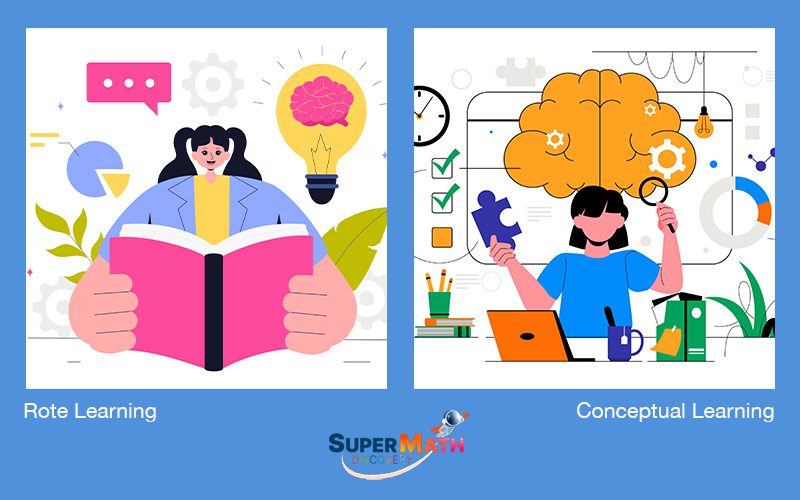
3.1. How Does Conceptual Learning Differ From Rote Learning?
When comparing rote memorisation vs conceptual learning, the differences become clear in the way each shapes a student’s experience of mathematics. Both have roles to play, but their impact on long-term success is not the same.
1. Learning Style
- In conceptual learning, students focus on meaning, relationships, and connections. Students ask “why” and “how” rather than just memorising steps.
- Rote memorisation, on the other hand, relies on repetition and drills to memorise isolated facts or formulas without necessarily understanding them.
2. Engagement Level
- Active learning in mathematics is encouraged when lessons are conceptual, involving reasoning, questioning, and exploration.
- Rote learning tends to be passive. Students may repeat answers correctly but without curiosity or deeper involvement.
3. Skill Development
- Conceptual understanding in mathematics builds higher-order skills such as reasoning, problem-solving, and analysis. These skills are essential for tackling challenging word problems in the Singapore syllabus.
- Rote strengthens quick recall but limits adaptability when faced with unfamiliar scenarios.
4. Application of Knowledge
- Conceptual learning supports transfer of knowledge. For instance, understanding ratios can later help with algebra, percentages, or real-life budgeting.
- Rote ties knowledge to specific, familiar question types, which can leave students unprepared for novel contexts.
5. Assessment Style
- Conceptual approaches are best assessed with open-ended tasks, reasoning questions, and real-world applications.
- Rote learning is usually tested through direct recall or multiple-choice questions.
Examples in Math:
- Multiplication: Memorising “5 × 6 = 30” (rote) versus understanding that multiplication is repeated addition (conceptual).
- Fractions: Reciting “multiply the numerators” (rote) versus using visual learning tools to see how parts of wholes interact (conceptual).
Overall, while memorisation provides speed, conceptual learning builds flexible and long-term competence.
3.2. What are the Limitations of Rote Memorisation in Math?
While memorisation has its uses, such as knowing multiplication tables or recalling formulas, it becomes problematic when it is the primary approach. Over-reliance on rote methods can create gaps in understanding and make students less prepared for higher-order tasks. Compared to conceptual learning, rote memorisation shows several clear limitations:
1. Lacks Depth and Flexibility
Students may successfully recite procedures but falter when questions are presented in unfamiliar formats. For instance, a child who only memorises “area = length × width” may struggle with irregular shapes or word problems. Without conceptual understanding, they cannot transfer knowledge to new contexts.
2. Weak Long-Term Retention
Facts learned by rote are often stored temporarily, just long enough for tests. Because they are not meaningfully connected to prior knowledge, they are easily forgotten. In contrast, long-term retention strategies that focus on understanding relationships help students retain knowledge well into future studies.
3. Reduces Critical Thinking and Independence
Rote methods encourage following instructions mechanically. Students may perform steps correctly but lack the confidence to analyse problems independently. This undermines the development of critical thinking and leaves learners reliant on guidance rather than their own reasoning.
4. Demotivates and Increases Anxiety
Endless drilling can feel repetitive and disengaging. When memorised methods do not apply to new questions, students often feel lost, causing them to feel frustrated. This can negatively affect their attitude towards maths as a subject.
These limitations highlight the importance of conceptual learning. By teaching the “why” alongside the “how,” students become more resilient, motivated, and capable of applying math problem-solving skills in a wide variety of situations.
3.3. How About Combining Rote and Conceptual Learning?
It is important to clarify that effective mathematics education is not about rejecting memorisation entirely. Students are still required to recall multiplication tables, formulae, and basic operations quickly. This efficiency frees up mental energy for more complex reasoning. However, when this fluency is paired with conceptual learning, the result is far more powerful and sustainable.
For example, a child who has memorised the times tables can calculate answers rapidly. Yet, when the same child also understands multiplication conceptually, they gain the flexibility to approach problems in different ways, such as breaking down 16 × 25 into smaller, manageable parts. This combination improves both speed and understanding, which together strengthen performance in mathematics.
The best approach is therefore one of balance, where both elements complement each other:
- Rote provides automaticity. With memorised facts at hand, students can work through problems quickly without hesitation.
- Conceptual learning provides adaptability and depth. Students understand not only the “how” but also the “why” behind each mathematical step.
This balanced method equips learners for higher-order exams, university-level mathematics, and complex problem-solving in real life. If you are looking for effective math tuition in Singapore, look for a centre that adopts this balance in the way their classes are taught.
FAQs
1. Isn’t it faster to just teach kids the steps?
Teaching steps may feel quicker at first, but it often creates gaps later. Students with conceptual understanding in mathematics are less likely to forget and more capable of adapting to new problem types.
2. Is conceptual learning suitable for all learners?
Yes. Whether a student is visual, auditory, or kinesthetic, conceptual learning can be conducted using tools like diagrams, discussions, or hands-on practice. This also explains why visual learning tools for maths are so powerful.
3. Does conceptual learning take more time?
Initially, yes. However, in the long run, conceptual learning saves time because it builds long-term math retention strategies and prevents repeated reteaching.
In Singapore, where the mathematics curriculum emphasises reasoning and problem-solving, it is not enough to rely solely on rote memorisation. Students need depth, flexibility, and confidence, which are all traits that conceptual learning is designed to develop.. By focusing on the “why” and “how,” children not only achieve better exam results but also gain lasting skills that extend into real life.
Here at SuperMath Learning Centre, we recognise the importance of finding the right balance between memorisation and conceptual learning. From regular classes to holiday maths camp, our programmes are designed to meet students where they are regardless of proficiency, supporting them holistically as they develop the skills needed to excel in mathematics and beyond. Whether your child is enrolled in our Parkway Parade tuition centre or taking classes online, our tutors remain committed all the same, ensuring that no student is left behind.
Enrol in our maths tuition programmes today and see the difference that true understanding can make.
For more information about our maths programmes, tutors, and teaching methodologies, please contact us today.
