
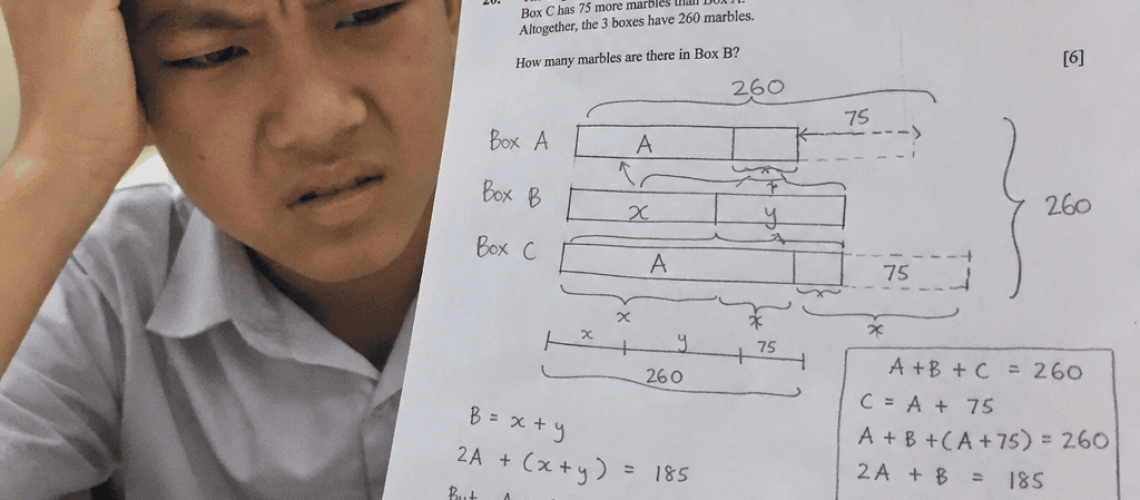
Are There Limitations to Model Drawing in PSLE Problem Sums?
For years, the visual bar model has been the undisputed champion of Singapore Maths. It is a brilliant tool for young learners, helping them translate abstract numbers into tangible blocks. However, as students progress to Primary 5 and 6, the sheer complexity of the syllabus often leaves parents and educators asking a critical question: are Singapore math models too time-consuming for exams?
When tackling high-stakes papers, every minute counts. Relying solely on drawing blocks can lead to messy working, frustrating errors, and a severe lack of time. In this comprehensive guide, we will explore the Limitations of model drawing in PSLE Maths problem sums and alternative strategies (Unit Listing, Branching, and simplified algebra) used by SuperMath. By expanding your child’s mathematical toolkit, you can help them tackle the most daunting questions with confidence, speed, and precision.
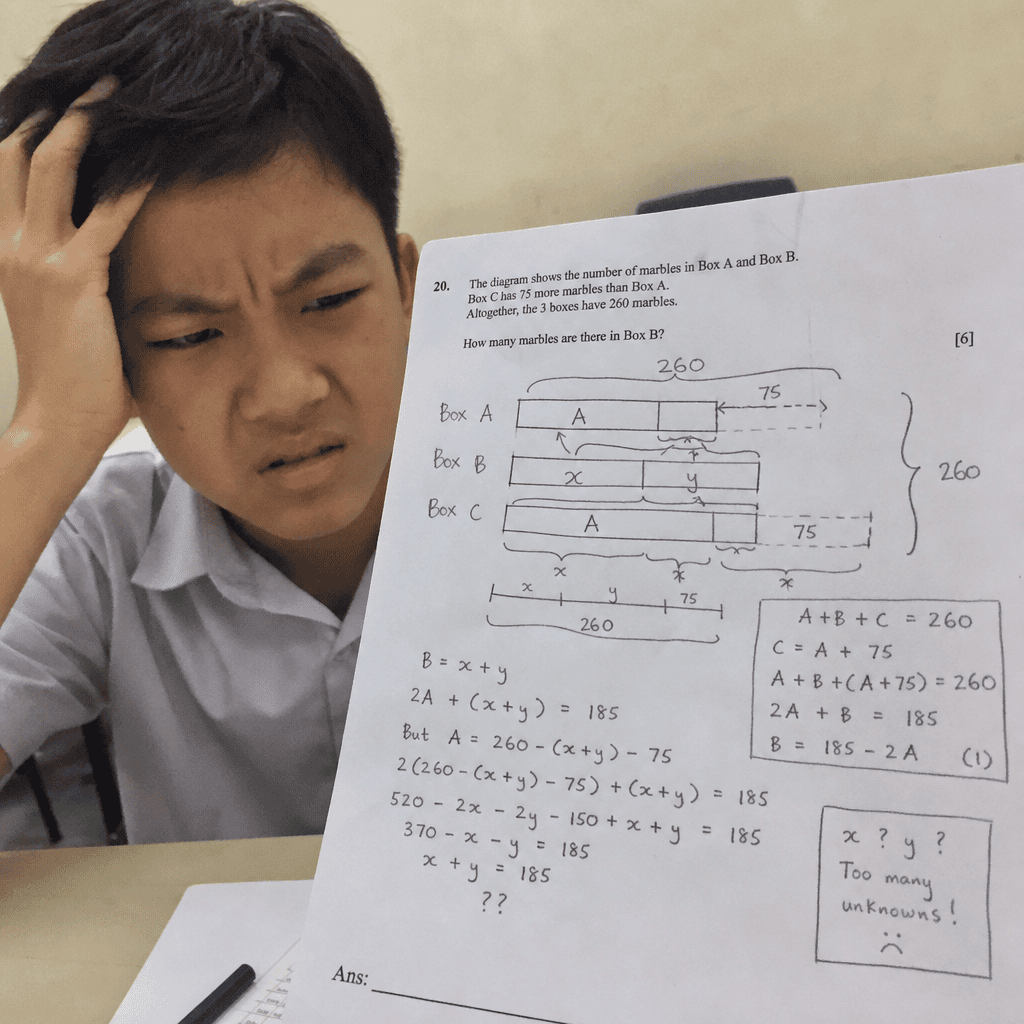
Core Issue: Why Model Drawing Fails for Complex PSLE Maths
There is no denying that drawing models is an excellent foundational step. However, the limitations of pictorial bar models in upper primary become glaringly obvious when students encounter multi-step heuristic questions.
Here is exactly why model drawing fails for complex PSLE maths:
- Microscopic Subdivisions: When a problem sum requires a student to divide a single block into increasingly smaller fractions or ratios, the drawing quickly becomes a cluttered mess. A student might draw five blocks, only to realise they need to subdivide each block into seven tiny pieces.
- Time Inefficiency: Drawing, erasing, and redrawing straight lines and perfectly proportioned boxes eats up precious exam time.
- The “Changing Quantity” Nightmare: In questions where both the ‘Before’ and ‘After’ quantities change (such as ‘Before-and-After’ ratio questions), drawing comparative models can become a geometrical nightmare.
- Lack of Scalability: A model that works for small numbers (like 3 units to 4 units) completely breaks down when dealing with larger values or complex percentages.
These model drawing limitations signal that a student is ready for a cognitive leap. Excelling in the national exams requires transitioning from models to abstract mathematical reasoning, allowing students to process information mathematically rather than merely visually.
Shifting Gears: Alternative Heuristic Strategies for PSLE Problem Sums
To score an AL1 or AL2, students must move beyond basic visual aids. This is where SuperMath steps in. The SuperMath curriculum is meticulously designed around solving primary school heuristics without drawing models.
Instead of forcing a one-size-fits-all visual approach, SuperMath introduces a robust framework of alternative heuristic strategies for PSLE problem sums. These methods are explicitly tailored to be efficient heuristics for PSLE paper 2 math, where questions are notoriously long and complex.
Let us delve into the three core alternative strategies that are transforming how students approach PSLE problem sums.
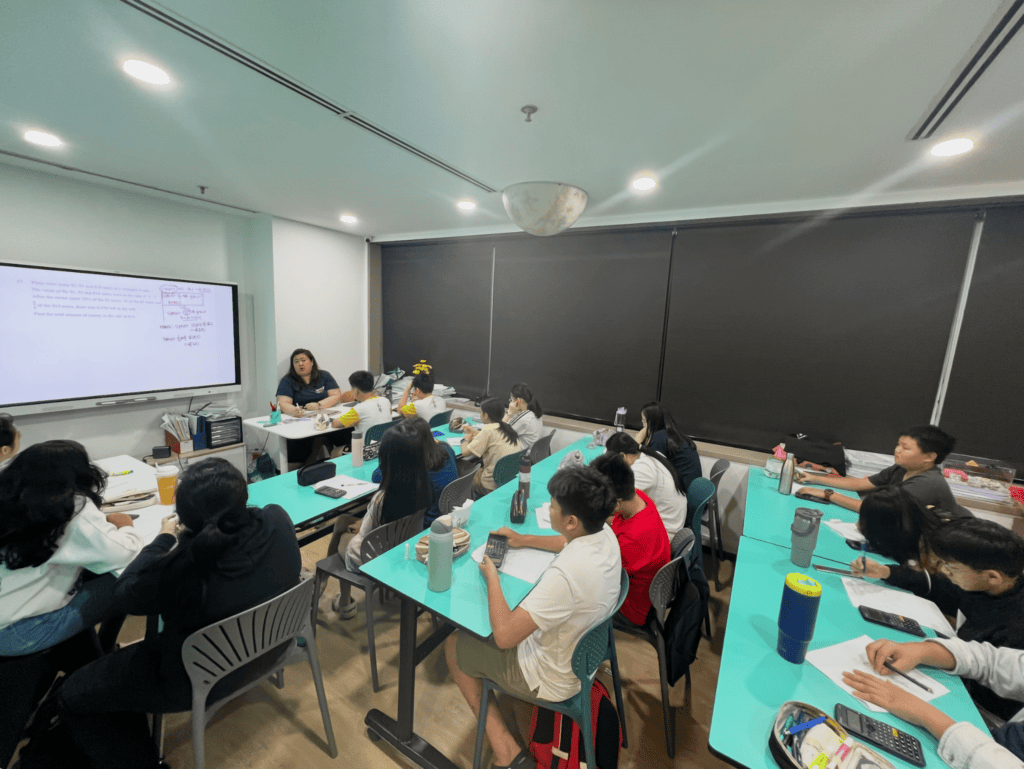
1. The Unit Listing Method: Speed and Accuracy Combined
If you are wondering how to solve complex ratio problems efficiently, the Unit Listing method is your definitive answer. Instead of drawing boxes to represent units, students use letters and numbers to represent quantities—most commonly, ‘U’ for Units and ‘p’ for parts.
A Quick Unit Listing Versus Bar Model Method Comparison
Imagine a scenario where the ratio of boys to girls in a hall is 3:5.
- The Bar Model Approach: A student draws 3 boxes for boys and 5 boxes for girls. Later, if 12 boys join and the ratio changes, the student has to draw a completely new set of boxes and try to align them to find the difference.
- The Unit Listing Approach: A student simply writes:
- Boys = 3u
- Girls = 5u
- New Boys = 3u + 12
- This directly translates into a swift mathematical equation.
This technique is a masterclass in primary school mathematical logic using unit systems. It entirely bypasses the need for a ruler and pencil, preventing visual clutter.
Guide to Mastering the Unit Listing Technique
To successfully apply this method, students should follow these actionable steps:
- Identify the Variables: Clearly list down the subjects (e.g., Apples and Oranges).
- Assign Units: Use ‘u’ to represent the base unit for the ‘Before’ scenario.
- Track the Change: Write down the exact numerical change (e.g., + 15, – 8).
- Formulate the ‘After’ Scenario: Create the final expression (e.g., 2u + 15).
- Equate and Solve: Cross-multiply or find the common multiple to solve for 1u.
Actionable Tip: Use Unit Listing for questions involving “Constant Part”, “Constant Total”, or “Constant Difference”. It is significantly faster than drawing ‘Before and After’ models and drastically minimises the risk of careless transfer errors.
2. The Branching Method: Taming the “Remainder” Beast
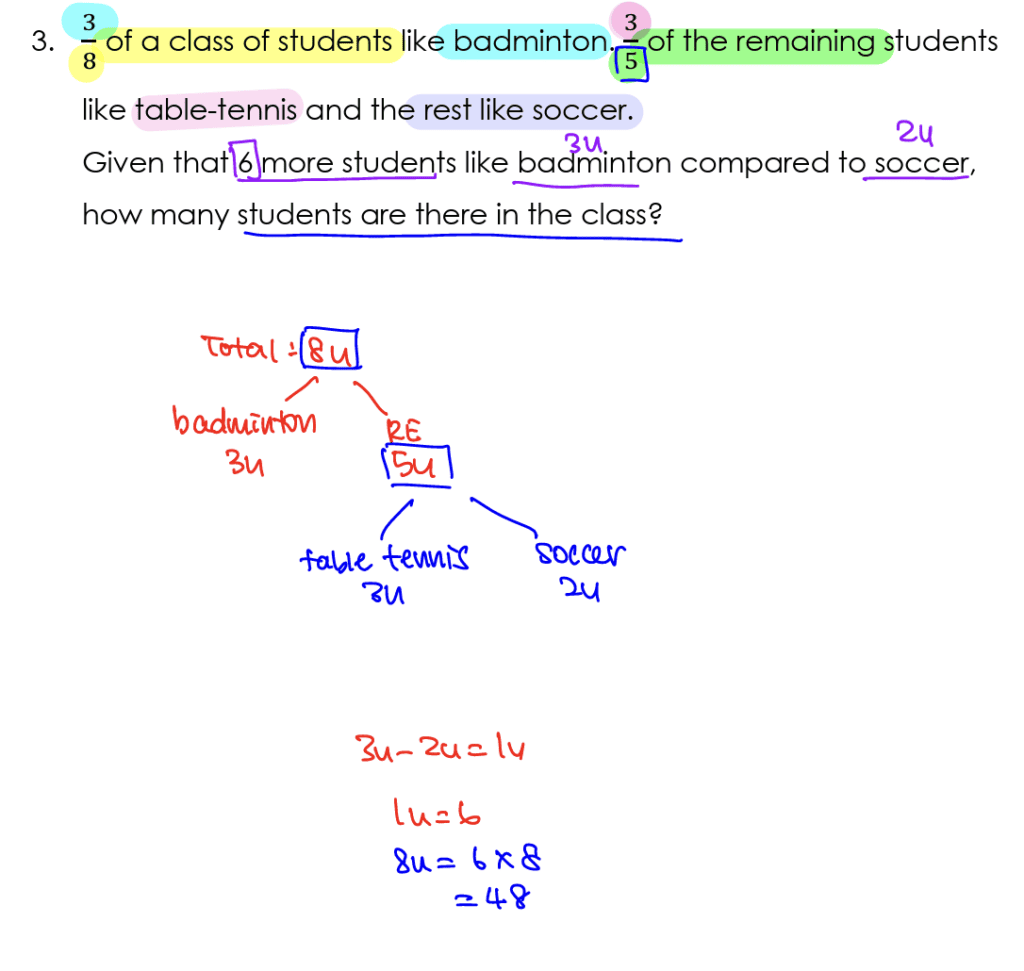
Remainder concepts are notorious for confusing Primary 5 and 6 students. A classic question usually reads something like: “Sarah spent 1/3 of her money on a bag, and 2/5 of the remainder on shoes…”
Attempting to draw a “drop-down” bar model for these fractions is incredibly tedious. You must calculate exactly how many boxes to drop down, how to subdivide them, and ensure all parts are mathematically equal.
When to Use Branching Method for Remainder Problems
You should deploy the Branching method the moment you spot the word “remainder” or see a sequence of consecutive spending/giving events in a problem sum. It is the ultimate tool for tracking quantities that are repeatedly split into fractions or percentages.
Solving Remainder Concept Sums Using Branching Diagrams
A branching diagram works like a family tree. It allows a student to map out the exact flow of the problem from top to bottom.
Here is how SuperMath breaks it down:
- Start with the Total at the top. Let’s call it ‘Total (1)’.
- Branch left for the fraction spent (e.g., 1/3 Bag).
- Branch right for the remainder (e.g., 2/3 Remainder).
- From the ‘Remainder’ branch, split again for the next transaction (e.g., 2/5 Shoes, 3/5 Leftover).
To find the true fraction of any final branch in relation to the total, you simply multiply down the branch path (e.g., 2/3 × 3/5 = 6/15 of the Total).
The speed benefits of SuperMath branching strategies cannot be overstated. What would normally take a student five minutes of frantic drawing and erasing can be mapped out in a neat, logical tree in under 60 seconds. It completely eliminates the visual ambiguity of drop-down models and provides a clear, mathematical pathway to the final answer.
3. Bridging the Gap: SuperMath Simplified Algebra for Upper Primary Students
There is a common misconception that algebra is strictly a secondary school topic. However, the PSLE syllabus covertly expects students to understand algebraic reasoning, even if it is disguised under the veil of “heuristics”.
SuperMath simplified algebra for upper primary students gently introduces 11- and 12-year-olds to the power of equations. By replacing a cumbersome question mark or an empty box with a simple letter (like $x or $y), students unlock a much higher tier of problem-solving efficiency.
Why Introduce Algebra Now?
By Primary 6, students are already manipulating unknown units (finding the value of 1 unit). Simplified algebra takes this a step further by teaching them how to balance equations and isolate variables.
For instance, in “Guess and Check” questions—which typically require students to draw massive, time-consuming tables—simplified algebra allows them to use the “Assumption Method” or set up a straightforward algebraic equation to find the answer in a fraction of the time.
Integrating this level of abstract thought prepares students not just for the PSLE, but ensures a seamless transition into Secondary 1 Maths. It relies on teaching the underlying mathematical laws rather than relying on rote memorisation of heuristic “tricks”.
Actionable Tip: Start small. Encourage your child to write simple mathematical sentences. If John has 5 more sweets than Peter, instead of drawing two models, teach them to write: $P = $x, $J = x + $5. This gentle exposure builds immense confidence.
Combining the Strategies: The Ultimate Toolkit
The most successful students do not rely on a single method. The true power of these PSLE Maths strategies lies in knowing when to deploy them.
- Use Unit Listing for ratio, percentage, and ‘Before-and-After’ changing quantity problems.
- Use Branching Diagrams for successive fractions, percentages, and remainder concepts.
- Use Simplified Algebra for complex assumption questions and bridging the gap in multi-variable problem sums.
By categorising questions and applying the most efficient strategy, students save time, reduce cognitive load, and drastically lower the chances of making careless mistakes.
Conclusion
So, are there limitations to model drawing? Absolutely. While the visual bar model will always hold an important place in early mathematical education, relying on it entirely in the upper primary years is like trying to build a modern skyscraper with a simple hammer. It works initially, but eventually, you need advanced tools for complex architecture.
Understanding the Limitations of model drawing in PSLE Maths problem sums and alternative strategies (Unit Listing, Branching, and simplified algebra) used by SuperMath is the first step towards academic excellence. By embracing the Branching method, the Unit Listing method, and simplified algebraic concepts, your child will no longer view Paper 2 as an insurmountable hurdle.
Instead, they will tackle their PSLE problem sums with the sharp, abstract, and rapid analytical skills of a true mathematician. Equip them with these alternative strategies today, and watch their confidence—and their grades—soar.
