
Key Takeaways:
- Why Are Exponentials, Logarithms, and Calculus More Than Just A-Maths Exam Topics?
- Understanding Exponentials and Logarithms allows students to interpret rapid change and solve equations with variables in the exponent.
- Calculus focuses on differentiation and integration. Its real-world applications span physics, engineering, economics, logistics, and modern fields.
- Mastering these topics sharpens abstract thinking, logical reasoning, and problem-solving skills.
- With reinforced support like tutoring, students are better prepared for H2 Math in JC and future STEM-related careers.
Introduction
When students reach Secondary 4 in Singapore, A-Maths topics take a major leap forward. You’re introduced to powerful abstract tools, such as calculus, exponentials, and logarithms, which go far beyond classroom exercises. These mathematical concepts serve as building blocks for understanding scientific models, economic behaviour, and engineering systems.
In this article, we explore why mastering these core topics is essential and how maths tuition in Singapore can support students on this journey.
What are Exponentials and Logarithms?
One of the first key topics students encounter is exponentials and logarithms. Essentially, exponential functions describe growth or decay, while logarithms are their inverse operations.
- Exponentials show how values can increase or decrease rapidly over time.
- Logarithms are used to “undo” exponentials, making them critical in solving equations with unknowns in the exponent.
In fact, exponential and logarithmic applications are not limited to textbooks. They are also seen in real-world contexts, including calculating compound interest in finance, measuring pH levels in chemistry, and modelling cooling in physics. By graphing these functions, students can understand how even small changes may produce significant shifts over time.
Why Exponentials and Logarithms Matter
Why does the syllabus emphasise them so much? Because they appear in almost every scientific and economic formula. From Newton’s Law of Cooling to exponential demand models in economics, these functions allow us to make sense of rapid change. Without them, it would be nearly impossible to model or predict real-world phenomena accurately.
For students, understanding these A-Maths topics strengthens logical thinking. They equip you with skills that will resurface in JC, university, and professional fields like data science, finance, and biology.
What is Calculus in Secondary School?
Next, we dive into the introduction to calculus in secondary school. Calculus focuses on these two ideas:
- Differentiation: Finding the rate of change or the gradient of a curve, useful in analysing speed, velocity, or optimisation problems.
- Integration: Calculating the area under a curve or the accumulation of values, essential in physics and statistics.
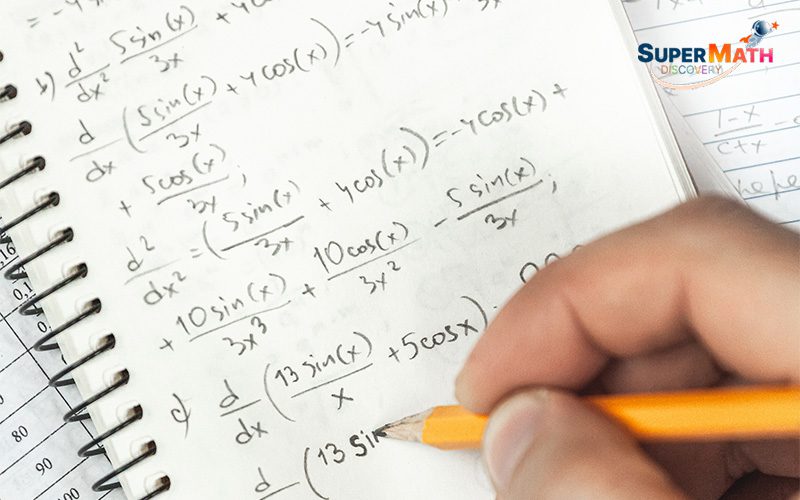
Calculus may sound intimidating, but it is simply a way of studying change. Its strength lies in the way it builds on the algebra and graphs you already understand. The real-world uses of differentiation and integration are everywhere, from calculating profit and loss curves in economics to determining optimal strategies in logistics.
Why Calculus Matters
Calculus lays the foundation for physics when studying motion. In engineering, it guides the design of complex systems. When it comes to modern fields such as artificial intelligence and data science, calculus is used to analyse data, optimise models, and predict outcomes.
How These A-Maths Topics Prepare Students for JC and Beyond
The leap to JC can be daunting, but a strong grounding in the aforementioned topics smooths the way. Calculus, exponentials, and logarithms form the backbone of H2 Maths, physics, chemistry, and economics. Apart from academics, they sharpen abstract thinking, logical reasoning, and structured problem-solving. These abilities equip students with the mindset needed to tackle challenges in higher education and future careers. To truly master these topics, students should complement classroom learning with reinforced academic support, such as guidance from an A-Maths tuition centre.
How to Master Important A-Maths Topics
1. Break it Down
Learn the rules of logarithms before attempting complex applications. By starting with smaller, manageable steps, you avoid feeling overwhelmed. Once the basics are clear, tackling tougher problems becomes easier.
2. Visualise with Graphs
Graphing functions makes abstract concepts clearer. When you can see how the curve rises or falls, the formulae begin to make more sense. Visual learning also helps you spot patterns that can be applied to different questions.
3. Relate to Real Life
Link exponentials to finance, or calculus to physics, so you understand their purpose. Real-world connections make abstract maths feel more relevant and less intimidating.
4. Practise Exam-style Questions
Exposure to word problems ensures you’re exam-ready. These questions test not just your understanding of formulas but also your ability to apply them in context.
While following these tips is important, students who still struggle can benefit from enrolling in additional maths tuition. With the guidance of experienced teachers, you do not just memorise formulae but truly understand the concepts. Structured practice and personalised support help you build confidence and prepare effectively for the challenges of JC.
At SuperMath, our specialised tuition programmes are designed to simplify complex ideas and reinforce core skills. Through our consistent cultivation of arithmetic concepts and heuristics, students can be well-equipped to prepare for H2 Maths in JC.
Contact us and let us enhance your mathematical thinking.
