

Key Takeaways:
- How Does the O-Level Math Syllabus Benefit Students Across Subjects?
- Science (Physics & Chemistry): Maths concepts like algebra, graphs, and equations are essential for solving problems involving speed, force, molar mass, and reaction rates.
- Geography: Data interpretation and mathematical concepts such as ratio, proportion, and scale are critical for analysing trends and map reading.
- Principles of Accounts (POA): Logical reasoning and accuracy developed through the maths syllabus help students prepare balance sheets, check calculations, and interpret financial data.
- Computing & Computer Applications (CPA): Algebraic thinking strengthens coding, algorithm design, and problem-solving skills in programming.
- Humanities: The structured, step-by-step mindset from maths supports argument development, source analysis, and critical thinking in essays.
Introduction
The O-Level Maths syllabus in Singapore is often viewed by students as just another subject to pass. The truth is, mathematics is not just about formulae and equations. In fact, it builds a foundation for thinking, analysing, and solving problems across many disciplines. Core skills like logical reasoning, data interpretation, and mathematical problem-solving extend beyond the exam hall to everyday life. They shape how students approach challenges in everyday life and nurture abilities that drive success in subjects such as Physics, Chemistry, Geography, and even the Humanities.
In this article, we explore how maths goes hand in hand with other disciplines and why mastering the syllabus can boost overall academic performance. Let’s also learn why students turn to O-Level Maths tuition for supplementary support.
How Does the O-Level Maths Syllabus Support Different Subjects?
1. Science Subjects (Physics and Chemistry)
Physics and Chemistry are often described as “maths in action”. Many scientific problems cannot be solved without mathematical concepts. In Physics, topics such as speed, acceleration, force, and energy rely on precise use of algebra, graphs, and formula manipulation.
Similarly, Chemistry involves calculations of molar mass, concentration, and reaction rates, all of which require a strong grasp of equations and proportional reasoning. Without mathematics, it would be nearly impossible to explain natural phenomena, analyse experimental results, or solve quantitative problems accurately.
2. Geography
Many people assume Geography is only about maps and physical landscapes, but the subject goes much deeper. Success in Geography requires strong analytical skills, as students often work with data interpretation in line graphs, pie charts, and histograms. These tools are used to identify and explain patterns such as population growth, urbanisation, and climate change.
In this context, mathematical concepts like ratio, proportion, and scale are crucial for accurate map reading and spatial analysis. By mastering the O-Level Math syllabus, students are better equipped with problem-solving and analytical skills to tackle climate data, compare demographic trends, and make sense of spatial patterns.
3. Principles of Accounts (POA)
Accuracy matters in POA. Every entry, balance, and statement relies on mathematical precision. Students use percentages, profit and loss statements, and interest calculations regularly. Here, logical reasoning and sequential thinking become essential.
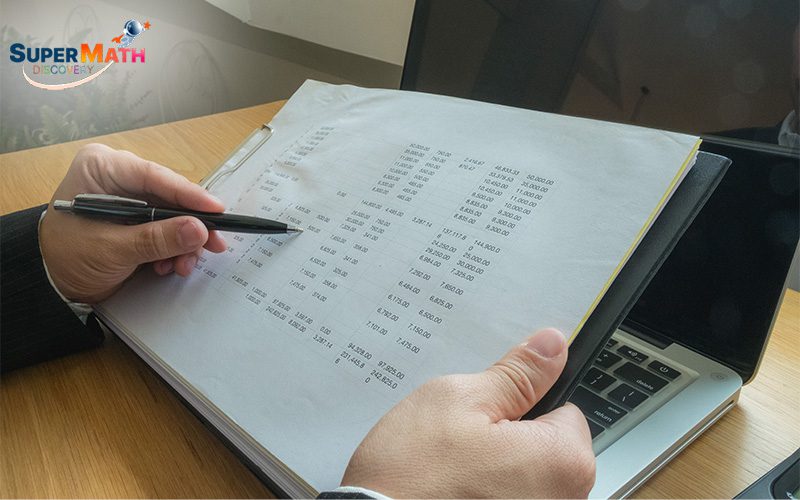
By applying the systematic approach learned in O-Level Maths, students are better equipped to manage ledger entries, spot errors, and interpret financial data. For instance, when preparing a balance sheet, a student may notice that the total assets do not match the liabilities and equity. They can use logical reasoning to retrace calculations by checking percentages, ratios, and arithmetic to identify where the error came from.
4. Computing and Computer Applications (CPA)
Behind every line of code is a logical framework. Algebraic thinking lays the groundwork for programming, algorithm design, and data handling. The ability to break down a problem into smaller, solvable steps mirrors the approach used in mathematical problem-solving.
This close connection between maths and computing shows why cross-disciplinary learning is valuable. A student who excels in maths is better prepared to handle computational challenges, develop coding logic, and think like a programmer. In mathematics, algebra builds the ability to work with abstract symbols and variables, which is the same mindset needed to understand coding syntax and functions.
5. Critical Thinking and Humanities
It may seem surprising, but the Humanities also benefit from maths. The structured, step-by-step mindset developed through problem-solving helps students craft stronger arguments in Social Studies or General Paper essays.
Maths also trains students to evaluate evidence, analyse patterns, and form reasoned conclusions. These are the skills that directly support source-based questions, literary analysis, and essay writing. By learning to think critically, students build the ability to assess information objectively, a skill that serves them well beyond academics.
How Students Benefit from Tuition
Given how interconnected the O-Level Math syllabus is with other subjects, many students turn to Maths tuition in Singapore for personalised guidance. Supported by a reliable tutor, students receive in-depth explanations to clarify difficult topics and apply maths more effectively across different disciplines.
At SuperMath, we use a progressive approach that builds confidence through simple examples before moving on to more complex problems. By connecting maths concepts to everyday life, we make learning more relatable and less intimidating.
Looking to enrol your child in a dependable tuition? Contact us to check on class availability.
